Bootstrap
自助法与置信区间
统计建模篇我很推崇infer基于模拟的假设检验。本节课的内容是用tidyverse技术重复infer过程,让统计分析透明。
R
library(tidyverse)
library(infer)

penguins <- palmerpenguins::penguins %>% drop_na()

point_estimate <- penguins %>%
  specify(response = bill_length_mm) %>%
  calculate(stat = "mean")

penguins %>%
  specify(response = bill_length_mm) %>%
  hypothesize(null = "point", mu = 40) %>%
  generate(reps = 5000, type = "bootstrap") %>%
  calculate(stat = "mean") %>%
  visualize() +
shade_p_value(obs_stat = point_estimate, direction = "two-sided")重复infer中null = "point"的抽样过程
- 零假设,bill_length_mm长度的均值是
mu = 40.
具体怎么做呢?
抽样
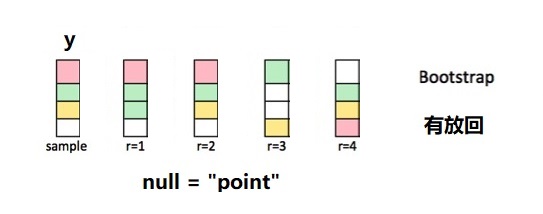
- 响应变量
y这一列,先中心化,然后加上假设条件mu - 针对调整后的这一列,有放回的抽样。
- 反复抽样
reps = 1000次
由图中可以看到,每次抽样返回的新数据框与原数据框大小相等,但因为是有放回的抽样,因此每次得到一个不同的集合,有的值可能没抽到,而有的值抽了好几次。下面以一个小的数据框为例演示
R
tbl <- tibble(
  y = 1:4,
  x = c("a", "a", "b", "b")
)
tbl
R
tbl %>%
  specify(response = y) %>%
  hypothesize(null = "point", mu = 4) %>%
generate(reps = 1, type = "bootstrap")先调整y列,然后有放回的抽样
R
mu <- 4
y <- tbl[[1]] - mean(tbl[[1]]) + mu
y_prime <- sample(y, size = length(y), replace = TRUE)

tbl[1] <- y_prime
tbl
也可以写成函数形式
R
bootstrap_once <- function(df, mu) {
  y <- df[[1]] - mean(df[[1]]) + mu
  y_prime <- sample(y, size = length(y), replace = TRUE)

  df[[1]] <- y_prime
  return(df)
}

tbl %>% bootstrap_once(mu = 4)这个操作需要重复若干次,比如100次,即得到100个数据框,因此可以使用purrr::map()迭代
R
1:100 %>%
   purrr::map(~ bootstrap_once(tbl))
为方便灵活定义重复的次数,也可以改成函数,并且为每次返回的样本(数据框),编一个序号
R
bootstrap_repeat <- function(df, reps = 30, mu = mu){
  df_out <-
    purrr::map_dfr(.x = 1:reps, .f = ~ bootstrap_once(df, mu = mu)) %>%
    dplyr::mutate(replicate = rep(1:reps, each = nrow(df))) %>%
    dplyr::group_by(replicate)

  return(df_out)
}

tbl %>% bootstrap_repeat(reps = 1000, mu = 4)
计算null假设分布
计算每次抽样中,y的均值
R
null_dist <- tbl %>%
  bootstrap_repeat(reps = 1000, mu = 4) %>%

  group_by(replicate) %>%
  summarise(ybar = mean(y))

null_dist
可视化
R
null_dist %>%
  ggplot(aes(x = ybar)) +
  geom_histogram(bins = 15, color = "white")
应用penguins
R
samples <- penguins %>%
  select(bill_length_mm) %>%
  bootstrap_repeat(reps = 5000, mu = 40)

null_dist <- samples %>%
  group_by(replicate) %>%
  summarise(stat = mean(bill_length_mm))

null_dist %>%
  ggplot(aes(x = stat)) +
  geom_histogram(bins = 15, color = "white")
R
obs_point <- mean(penguins$bill_length_mm)
p_value <- sum(null_dist$stat > obs_point) / length(null_dist$stat)
p_value也可以用rowwise()写
R
mu <- 40

update <- penguins %>%
  mutate(
   bill_length_mm = bill_length_mm - mean(bill_length_mm) + mu
  )


null_dist <- tibble(replicate = 1:1000) %>%
  rowwise() %>%
  mutate(hand = list(sample(update$bill_length_mm, nrow(update), replace = TRUE))) %>%
  mutate(points = mean(hand)) %>%
  ungroup()

null_dist
R
null_dist %>%
  ggplot(aes(x = points)) +
  geom_histogram(bins = 15, color = "white")
参考
- <https://www.tidyverse.org/blog/2021/08/infer-1-0-0/>
- <http://ritsokiguess.site/blogg/posts/2021-11-14-tidy-simulation/>
R
pacman::p_unload(pacman::p_loaded(), character.only = TRUE)